A marketing director at a mid-size software company in Bengaluru discovered the problem before a sales call. A potential enterprise client had typed the company name into ChatGPT and received a confident response stating the company had discontinued its flagship product two years earlier. The product was live, growing, and had recently won an industry award. By the time the sales team joined the call, the prospect had already formed a negative impression that no product demonstration could fully reverse.
This scenario is far from uncommon. Brands across India and the United States experience it every day, often quietly and without notifying the companies involved.
| Definition: AI brand hallucination occurs when a large language model such as ChatGPT, Gemini, Perplexity, Claude, or Microsoft Copilot provides factually incorrect information about a company and presents it as verified fact. The response may not include any uncertainty or disclaimer, leaving readers with no clear way to tell accurate brand information apart from fabricated or outdated content. |
1. Background and Scope of the Problem
AI brand hallucination is a structural characteristic of how large language models work, not a software bug in the conventional sense. A language model does not query a verified database when a user asks about a company. It predicts the most statistically likely response based on patterns absorbed during training. When training data is thin, outdated, contradictory, or absent, the model fills the gap with plausible-sounding content.
Research published by MIT in January 2025 found that AI models are 34 per cent more likely to use confident language, including phrases such as “definitely” and “without doubt”, when generating incorrect information than when stating accurate facts. The implication is direct: a hallucinated answer often sounds more certain than a correct one.
| “An AI hallucination about a brand is usually a stale source repeated faithfully, not an invented fact. A brand’s own website is only 5 to 10 per cent of what a model reads.”Ambika Sharma, Founder and Chief Strategist, Pulp Strategy Communications | NeuroRank Brand Visibility Research, July 2026 |
For general knowledge queries, which most closely overlap with brand facts, pricing, and product details, the average hallucination rate across major AI models is 9.2 per cent. However, that rate increases significantly when the queries become more specific.
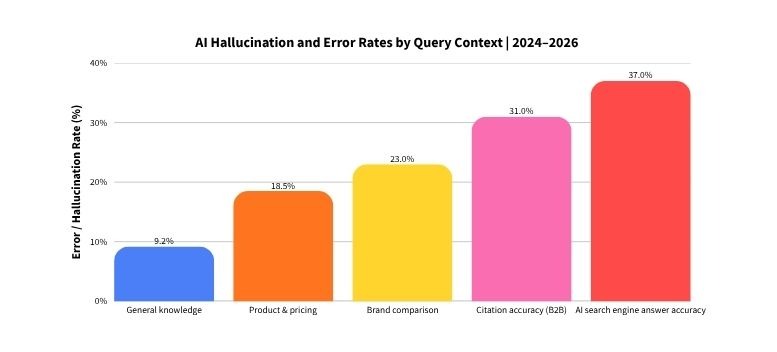
AI Hallucination and Error Rates by Query Context
The Tow Center for Digital Journalism at Columbia University tested eight AI search engines in March 2025. Each engine received an excerpt from a real, published article and was asked to identify its headline, publisher, publication date, and URL. Across 1,600 queries, the engines returned incorrect answers more than 60 per cent of the time. Even Perplexity, which was the most accurate of the eight platforms tested, still gave incorrect answers 37 per cent of the time.
2. Why Different Platforms Produce Different Errors
Not every AI platform hallucinates in the same way. Understanding the error patterns by platform determines which corrective action should take priority.
| Platform | Primary error type | Root cause | Most common symptom |
|---|---|---|---|
| ChatGPT | Feature conflation and fabricated specifics | High reliance on training data; fills gaps with plausible-sounding details from similar companies | Wrong founding year, fabricated product features, invented personnel names |
| Perplexity | Outdated information presented as current | Retrieves from live web sources, but older pages often rank higher than newer ones | Discontinued products described as active, stale pricing, previous leadership listed as current |
| Gemini | Competitive misattribution | Synthesises from multiple comparison articles, which can merge two similar entities | Competitor features attributed to your brand, or your product reviews applied to a competitor |
| Claude | Conservative omission with occasional specificity errors | Trained to hedge on uncertain facts; may still generate incorrect product specifics | Responses that mix accurate general facts with incorrect specific details |
3. The Business Cost
Most brands in India and the United States track website traffic, conversions, keyword rankings, and social media engagement. But very few monitor what AI systems say about their brand between a prospect’s first question and their first click on the website.
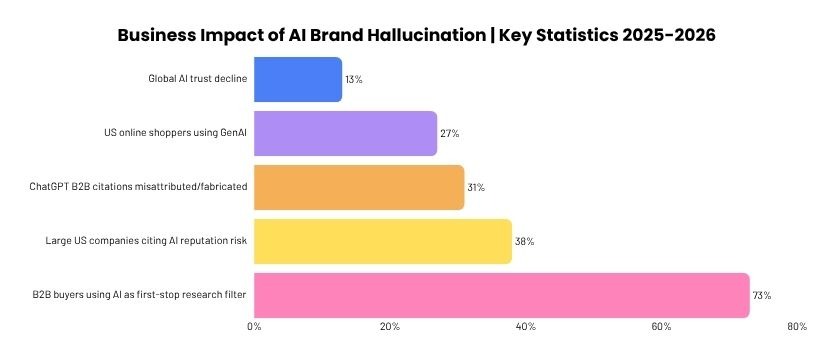
Business Impact of AI Brand Hallucination: Key Statistics 2025–2026
According to PAN Communications’ 2026 research of senior-level B2B buyers in the United States, 73 per cent now use AI as their first stop when researching and evaluating vendors. PAN’s analysis also found that 31 per cent of citations provided by ChatGPT for senior-level B2B queries were either misattributed or completely fabricated.
AI reputation risk is also becoming a bigger concern for large US companies. In 2025, 38 per cent identified it as their primary business concern, putting it ahead of cybersecurity at 20 per cent. Research from The Conference Board and ESGAUGE found that this was the first year AI-related reputation risk ranked higher than cybersecurity in the survey’s history.
| The invisible problem: Standard analytics tools do not record what a prospect read in an AI response before deciding not to contact a company. The hallucination occurs upstream of the click and remains entirely invisible to Google Analytics, Search Console, and CRM pipelines. |
In India, this problem is often made worse by what can be called entity thinness. Many Indian brands have limited representation across the open-web sources that AI models rely on most heavily. With fewer Wikipedia mentions, Wikidata entries, and international press coverage, AI models have less reliable information to work with and are more likely to fill those gaps with hallucinated content.
For Indian brands targeting US clients, the issue can become even more complicated. A US-based AI model may combine limited entity data from Indian sources with outdated or incorrectly attributed information from the relatively small amount of US-indexed content available about the company. The result can be a hallucinated answer that looks credible but does not accurately represent the brand.
4. How to Detect Hallucinations About Your Brand
The detection process requires no specialist tools at the initial stage. It requires time, four accounts on major AI platforms, and a structured recording method.
Step 1: Run the manual brand audit
Open each of the four major platforms (ChatGPT, Gemini, Perplexity, and Claude) and ask the following six questions, substituting the actual brand name, primary product name, and main service category:
- “What is [brand name]?”
- “What does [brand name] do?”
- “Tell me about [brand name]’s [main product or service].”
- “Compare [brand name] with [main competitor].”
- “Who founded [brand name] and when?”
- “Should I use [brand name] for [primary use case]?”
Screenshot every response. For each response, record which facts are stated, which are incorrect or outdated, what sentiment is expressed about the brand, and whether the brand is described accurately or confused with another entity.
Step 2: Classify every incorrect claim
Sort each wrong statement into one of three categories based on the table in Section 2 of this article: fabricated fact (something that was never true), stale fact (something that was once true but is no longer current), or entity confusion (information that belongs to a competitor or a similarly named company). The classification determines which corrective action to apply.
Step 3: Identify the source where possible
For Perplexity and Gemini, check the cited URLs to see whether the wrong claim comes from the source or from the AI misreading accurate information. If the source is outdated, publish updated content. If the source is accurate, restate the correct fact clearly and consistently across multiple authoritative sources.
5. Eight Corrective Actions
Fixing AI brand hallucinations starts with improving the quality and consistency of the information AI models find about a brand across the sources they rely on. These eight actions are ordered from the quickest observable impact to the longest implementation timeline.
1. Publish a Brand Facts page. Create a dedicated page at yourdomain.com/about or yourdomain.com/brand-facts covering key facts in plain language: legal company name, founding year, founders, headquarters, products or services, pricing range, and what the company does not offer. Keep it factual, concise, and free of marketing language. Link to it from the homepage and make sure AI crawlers can access it.
2. Fix Organisation schema markup. Your homepage’s Organisation schema is an important structured data asset for brand accuracy. At minimum, include @id, name, foundingDate, description, URL, and sameAs links to authoritative profiles such as LinkedIn, Google Business Profile, Crunchbase, Wikidata, and relevant industry directories. Consistent links help AI systems verify the brand across trusted sources, while conflicting information can increase hallucination risk.
3. Create or correct the Wikidata entity. Wikidata is an open knowledge base used by Wikipedia, Google’s Knowledge Graph, and various AI systems. Search for your brand on Wikidata. If no entry exists, create one. If it does, check that the founding date, headquarters country, industry, and official website are accurate and up to date.
| India-specific note: Many Indian brands, including established agencies and well-funded startups, have no Wikidata entity. Creating one is free and can provide AI systems with a structured source for verified brand information. |
4. Unify entity signals across third-party profiles. AI models build their understanding of a brand by combining information from multiple sources. If LinkedIn says the company was founded in 2019, Crunchbase says 2020, and the website says 2018, the conflicting information can create confusion. Check Google Business Profile, LinkedIn, Crunchbase, G2, Clutch, industry directories, and marketplace listings. Keep key details such as the company name, founding year, description, and services consistent across all profiles.
5. Publish fresh, dated content with key facts. RAG-based platforms such as Perplexity retrieve information from live web sources. If the most visible page about a brand is an outdated press release, the platform may rely on information that is no longer accurate. Publish fresh content with clear dates and current facts, such as updated About pages, product updates, and relevant press releases.
6. Audit and correct the robots.txt file. If AI crawlers cannot access your website, RAG-based platforms may fall back on older training data. Check yourdomain.com/robots.txt for rules affecting GPTBot, ClaudeBot, PerplexityBot, OAI-SearchBot, or Google-Extended. Some websites unintentionally block these crawlers through broad Disallow rules.
7. Earn authoritative third-party mentions. AI models tend to trust information that appears consistently across multiple credible sources. A fact mentioned only on your website is weaker than one supported by industry publications, technology directories, and relevant community platforms. For Indian brands targeting US audiences, credible US-indexed mentions can also strengthen the information available to US-based AI platforms.
8. Publish an llms.txt file. An llms.txt file at yourdomain.com/llms.txt can guide AI systems to the most useful and authoritative pages on your website. It helps highlight reliable brand facts, product information, and key company content. It is also a relatively low-effort LLMO (Large Language Model Optimisation) implementation.
6. Ongoing Monitoring
Correcting AI brand hallucinations is not a one-time task. It requires ongoing monitoring and maintenance.
AI models periodically retrain on updated datasets. A fact corrected across a brand’s website and third-party profiles can resurface after a new training cycle if accurate signals weaken, a new inaccurate source becomes prominent, or another source publishes conflicting information.
A quarterly review can help catch these issues early. Every three months, repeat the six-query audit across all four platforms and track how each one describes the brand. If a new hallucination appears, identify its source and apply the relevant corrective action from Section 5.
| Quarterly AI brand monitoring checklist: Run six brand queries on ChatGPT, Gemini, Perplexity, and Claude. Check Google Knowledge Panel for factual accuracy. Verify that the Wikidata entry is still correct and complete. Review the top five organic search results about the brand for outdated claims. Track branded search volume trend in Google Search Console as an indirect proxy for AI-driven brand awareness. |
7. India and USA Context
The AI hallucination problem can look different across markets, and understanding these differences helps determine which corrective actions to prioritise.
Indian brands
For Indian brands, the main challenge is entity thinness. Many established Indian companies have limited representation across the open web datasets used to train major AI models. Wikipedia coverage may be limited, Wikidata entries may not exist, and international press mentions are often fewer. As a result, AI models have less reliable information about these brands and may fill the gaps with plausible but incorrect details.
The top priorities for Indian brands are creating a Wikidata entity, implementing complete Organisation schema markup, and earning at least two mentions in internationally indexed publications that clearly state accurate brand facts.
US brands
For US brands, the main challenge is often outdated information being repeated across sources. These brands usually have a strong open web presence, but much of the available content may no longer reflect recent rebranding, pricing changes, product launches, or leadership changes. AI models can retrieve this older information and present it as current.
The key priorities for US brands are auditing high-ranking third-party pages for outdated information, publishing fresh, timestamped content that clearly reflects the current brand positioning, and updating schema markup to match the current product portfolio.
Indian brands targeting the US market
This situation combines entity thinness from the Indian side with stale or misattributed source retrieval from whatever limited US-indexed content exists. The corrective approach requires working both problems simultaneously: building the entity signals that reduce hallucination from thin data (Wikidata, schema, consistent third-party profiles) and earning US-indexed mentions that give RAG-based platforms accurate, current content to retrieve.
One accurate, well-placed mention in a US technology or trade publication will do more to reduce hallucination for US-based AI platforms than multiple updates to India-only directories.
8. Frequently Asked Questions
Q: What exactly is AI brand hallucination?
AI brand hallucination happens when a large language model gives confident but factually incorrect information about a company, its products, pricing, leadership, or services. Unlike a negative review or critical article, a hallucinated answer may not come from any real source. The model may invent the information, infer it from similar companies, or repeat outdated information as if it were current. In each case, the response can sound just as authoritative as accurate information.
Q: Why are Indian brands more vulnerable to AI hallucinations than US or European brands?
AI hallucinations can be more common for Indian brands than for comparable US or European brands because of a structural gap. Indian brands often have less representation in the open web datasets used to train AI models. Fewer Wikipedia mentions, Wikidata entries, and international press coverage mean AI systems have less reliable information to work with, making them more likely to fill the gaps with hallucinated content. The risk can be even higher for Indian companies targeting US clients, as US-based AI models may have less accurate information about them.
Q: Is there a way to contact ChatGPT or Google to correct a hallucination directly?
As of August 2026, there is no formal correction mechanism for brand-specific hallucinations across major AI platforms. The practical approach is to improve the information models can access by correcting inaccurate third-party sources, strengthening Wikidata and schema data, publishing fresh content, and building consistent brand signals across the web. Models gradually pick up these changes through new training data and RAG retrieval.
Q: How long does it take to correct an AI brand hallucination?
It depends on the type of hallucination. Technical fixes such as unblocking AI crawlers, publishing an llms.txt file, or correcting schema markup may improve RAG-based platforms like Perplexity within days or weeks. Training data hallucinations, such as an incorrect founding year or fabricated feature, can take longer and may require two to six months of consistent signals across authoritative sources. Ongoing monitoring should be done quarterly.
Q: What is the sameAs schema property and why does it matter?
The sameAs property in the Organisation schema contains URLs to authoritative third-party profiles such as LinkedIn, Wikidata, Google Business Profile, Crunchbase, and industry directories. These links help AI systems connect the brand website with trusted external entities. Keeping them accurate and consistent can improve confidence in brand information and reduce incorrect alternatives.
Q: What is the first step a brand should take today?
Start with the manual audit in Section 4. Ask ChatGPT, Gemini, Perplexity, and Claude: “What is [brand name]?” and “What does [brand name] do?” Save each response and check for factual errors. This gives you a clear starting point and helps identify which facts are wrong and which platforms need attention first.
Q: How often should the monitoring be repeated?
A quarterly review is a practical minimum. AI models regularly process new data, so corrected information can resurface if accurate brand signals weaken. Repeat the six-query audit every three months and update your schema and Wikidata whenever major facts change, such as pricing, products, or leadership.
Q: Can well-known brands also experience AI hallucinations?
Yes, but the risks differ. Smaller and newer brands often face hallucinations because there is not enough reliable information available, so AI models may fill the gaps with invented details. Well-known brands have more data, but it can include outdated, conflicting, or inaccurate information collected over the years. More data does not always mean more accurate answers.
Conclusion
AI brand hallucinations are happening across markets and affecting brands of all sizes. A potential client in Chicago or a procurement officer in Mumbai may already have received incorrect information about a company from an AI platform they trust, often without the company ever knowing about it.
The corrective steps covered in this article are not technically complex. They require consistency, patience, and treating AI brand accuracy as an ongoing process rather than a one-time project. Start with an audit of ChatGPT, Gemini, Perplexity, and Claude. What these platforms say about your brand today becomes the baseline for measuring future improvements.
For Indian brands targeting the US market, this work is especially important. The gap between how well defined US brands are in AI systems and how well defined most Indian brands are creates both a risk and an opportunity. Brands that close this gap early can put themselves in a stronger position to be recommended when the next prospect asks.
| Find Out What AI Is Saying About Your Brand Digilligence runs AI brand visibility audits across ChatGPT, Gemini, Perplexity, and Claude. Identifying hallucinations, entity gaps, and the exact corrective steps for both Indian and US markets. Visit digilligence.com to start your AI brand audit |