LLMO (Large Language Model Optimization) is the process of helping AI understand, trust, and accurately represent your brand. Instead of focusing on where your website ranks in Google, LLMO focuses on what AI tools like ChatGPT, Gemini, Perplexity, Claude, and Microsoft Copilot say when someone asks for recommendations.
Imagine someone asks ChatGPT, “Which digital marketing agency should I hire in India?”
ChatGPT recommends three agencies, but yours isn’t one of them. Not because your services aren’t great, but because AI doesn’t have enough trusted signals to recognize your brand.
That’s exactly what LLMO solves.
In 2026, those conversations are happening every day. If your brand isn’t part of them, you’re missing opportunities before customers even visit your website.
| 1B+ChatGPT monthly active users (June 2026)Reuters / Sensor Tower | 2.5BPrompts processed by ChatGPT every dayOpenAI, 2026 | 25%Projected drop in traditional search volume (2026)Gartner, Feb 2024 | 14.2%AI-referred traffic conversion rate vs Google 2.8%Exposure Ninja, 2026 |
1. What Is LLMO? The One Paragraph Answer
Large Language Model Optimization (LLMO) is the process of helping AI models like ChatGPT, Google Gemini, Perplexity, Claude, and Microsoft Copilot understand, trust, and accurately represent your brand, products, and expertise.
It works across two distinct layers:
- Training data influence: Building brand signals across the open web (Wikipedia, Reddit, trade publications, review platforms) so future AI model training datasets include accurate, positive representations of your brand.
- Real-time retrieval: Structuring your website content, technical setup, and entity data so AI models can retrieve and cite you in live responses – even in today’s models, right now.
LLMO doesn’t replace SEO. It builds on it. The same trust, authority, and high quality content that help you rank in search also help AI decide whether your brand is worth mentioning. The difference is that LLMO looks beyond your website and strengthens your reputation across the wider web, where AI gathers the signals it relies on.
2. The Numbers Behind the Shift: Why 2026 Changes Everything
The shift to AI search isn’t coming. It’s already here, and the numbers make that clear.
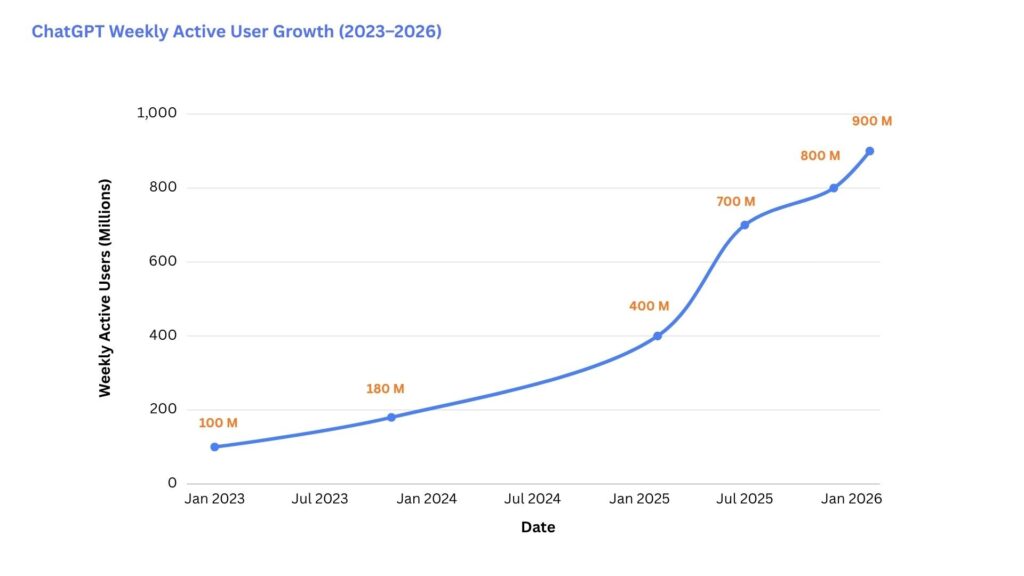
ChatGPT surpassed 1 billion monthly active app users in June 2026, becoming the fastest app ever to reach that milestone. It now handles 2.5 billion prompts every day, and India has more than 100 million weekly active users, making it OpenAI’s second largest market.
The broader AI search landscape tells the same story:
- 49% of ChatGPT usage is for recommendations, advice, and research, the types of queries that once went straight to Google.
- AI platforms generated 1.13 billion referral visits in June 2025, a 357% year over year increase.
- 58.5% of Google searches in the US end without a click, rising to 65 to 69% on mobile.
- Google AI Overviews now appear in 82% of B2B technology searches and 88% of healthcare searches.
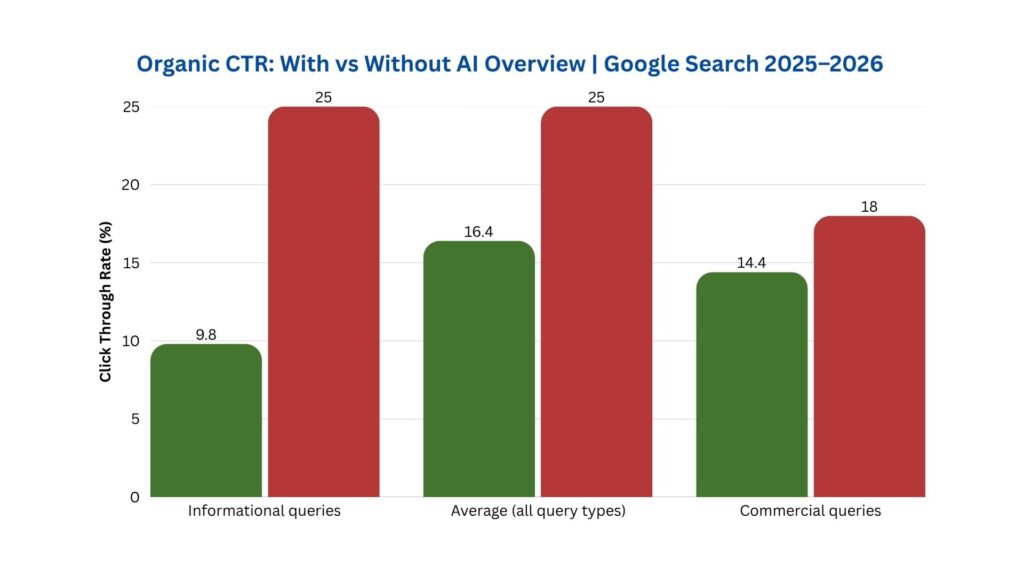
The takeaway is simple: People are no longer just searching. They’re asking AI. If your brand isn’t visible in those answers, you’re missing a growing share of customer discovery.
| Key Insight: Gartner predicts traditional search engine volume will drop 25% by 2026, with search marketing losing market share to AI chatbots and virtual agents. For informational content verticals, this prediction may already be conservative. |
3. What Industry Leaders Are Saying
The strategic shift toward AI-powered search isn’t speculation. The people running the platforms shaping this change have been on record about it for over a year.
| “Generative AI solutions are becoming substitute answer engines, replacing user queries that previously may have been executed in traditional search engines.”— Alan Antin, Vice President Analyst, Gartner — February 2024 |
| “As AI continues to expand the universe of queries that people can ask, 2025 is going to be one of the biggest years for search innovation yet — search is slowly becoming more like an AI assistant that browses the internet for you and returns an answer.”— Sundar Pichai, CEO, Google — Earnings Call, February 2025 |
| “The path to purchase is moving inside the answer itself, compressing what used to be multiple clicks into a single response. Your brand can no longer rely on traditional search visibility.”— Dave Yovanno, CEO, impact.com — Forbes, May 2026 |
These are not just opinions. They are the strategic perspectives of the CEO of Google, a senior Gartner analyst, and the CEO of a major marketing platform. Together, they point to the same structural shift. LLMO is how you respond to it.
4. How AI Models Actually Know About Your Brand
Before you can optimize for LLMs, it’s important to understand how they learn about your brand. That happens in two different ways.
Pathway 1: Training Data (Parametric Memory)
Every major LLM is trained on a massive snapshot of the internet, including Wikipedia, Reddit, news sites, research papers, product reviews, and online discussions. The information it learns during training becomes its baseline understanding of your brand. In other words, what AI has seen across the web shapes what it already “knows” before anyone asks a question.
If your brand was mentioned frequently and positively in credible sources before the model’s training cutoff, that positive association gets baked in. If you were absent, or described inconsistently, the model either ignores you or gets you wrong. This is the long game of LLMO.
Pathway 2: Live Retrieval (RAG)
Retrieval-Augmented Generation (RAG) allows AI models to search the live web in real time before generating a response. When someone asks Perplexity “what’s the best SEO agency in India,” Perplexity crawls live sources, extracts relevant information, and synthesizes an answer citing the most credible pages.
Key Takeaway: New content published on a trusted website can start receiving AI citations in just 3 to 5 days. However, these citations often decline after 4 to 5 days if not updated. Keeping content fresh and regularly updated gives your brand a clear advantage over AI systems relying on real-time retrieval, like RAG.
LLMO vs SEO vs AEO vs GEO: What’s the Difference?
These four terms are frequently confused. Here is the precise distinction between each discipline and what it targets.
| Discipline | Full Name | Primary Goal | Key Surfaces | Time to Results |
|---|---|---|---|---|
| SEO | Search Engine Optimization | Rank in traditional organic results | Google, Bing | Weeks – months |
| AEO | Answer Engine Optimization | Get extracted as the direct answer | AI Overviews, Featured Snippets, Voice | Weeks – months |
| GEO | Generative Engine Optimization | Get cited as a source in AI responses | ChatGPT, Perplexity, Gemini, Copilot | Weeks – months |
| LLMO | Large Language Model Optimization | Shape what AI models know & say about your brand — always | All LLMs — search mode AND chat mode | 3 – 12 months |
The simplest way to remember the difference:
- AEO = get extracted
- GEO = get cited
- LLMO = get remembered
All four build on the same foundation of quality content and genuine authority. But LLMO specifically answers the question: What does an AI model believe about my brand when no live search is happening at all?
6. The 6 Core Pillars of LLMO
LLMO is built on six interdependent pillars. Neglect any one of them and your AI visibility will have a real gap in it.
Pillar 1: AI Crawler Accessibility
LLMs cannot cite what they cannot read. The AI crawlers that matter most in 2026, by share of total AI bot traffic on Cloudflare’s global network (May 2026):
- GPTBot (OpenAI / ChatGPT) — 11.48% of all AI bot traffic
- ClaudeBot (Anthropic / Claude) — 9.73% of all AI bot traffic
- PerplexityBot, OAI-SearchBot, Google-Extended, Applebot-Extended
Check your robots.txt file. Rules added years ago to block scrapers may also be blocking AI crawlers. If an AI crawler can’t access your site, it can’t cite your content, no matter how good it is.
Pillar 2: Entity Clarity and Consistency
AI needs a clear understanding of who you are. Make sure your brand name, founding year, description, and services are consistent across your website, Google Business Profile, LinkedIn, Crunchbase, and other trusted directories.
A Wikidata entity is especially valuable because it helps AI identify and understand your brand with greater confidence. If you don’t have one yet, creating it is one of the highest impact LLMO improvements you can make.
Pillar 3: Original, Citation Ready Content
AI doesn’t cite content just because it’s well written. It cites content that adds something new.
Original research, survey data, real case studies, proprietary benchmarks, and expert insights are far more likely to be referenced than articles that simply reword existing content. If you want AI to cite your brand, create content that’s worth citing.
Pillar 4: Structured Data and Schema Markup
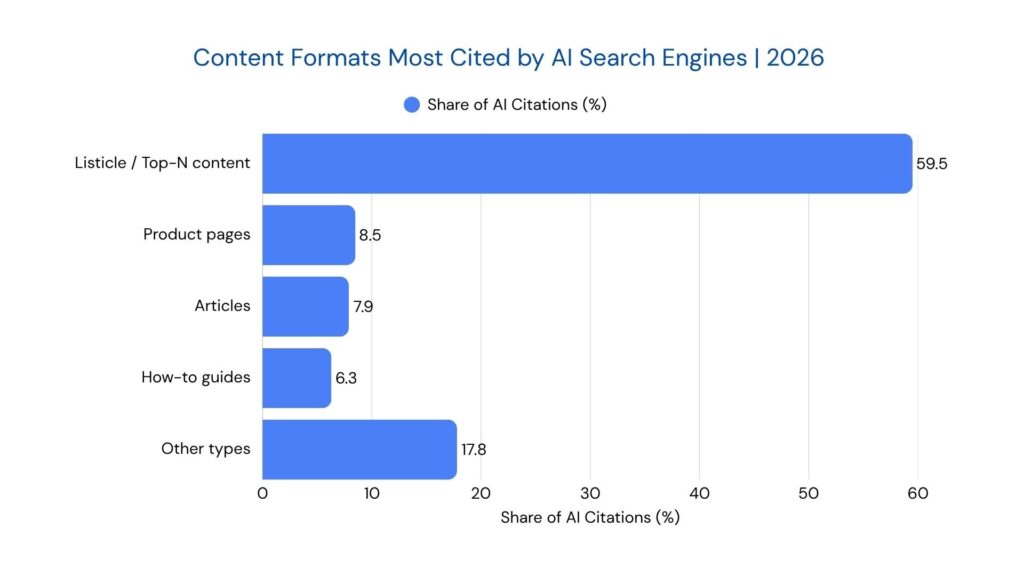
Schema markup helps AI crawlers understand your content by providing clear, machine readable information. The most important schema types for LLMO in 2026 include:
- FAQPage – Helps AI extract structured questions and answers for AI Overviews and chat responses.
- Article (with author, datePublished, and dateModified) – Signals content freshness and authorship.
- Organization (with complete sameAs links) – Strengthens your brand entity across the web.
- HowTo – Makes step by step content easier for AI and voice assistants to surface.
- DefinedTerm – Helps AI understand and present your definitions accurately.
Pillar 5: Third Party Brand Signals
According to Yext (2026), 86% of AI citations come from sources outside a brand’s own website. That’s why your website alone isn’t enough.
AI models rely heavily on platforms like Reddit, Quora, G2, Trustpilot, trade publications, and industry roundups. With Google’s partnership with Reddit, Reddit has become an even stronger source for AI Overviews and AI generated answers.
Pillar 6: llms.txt
An llms.txt file at yourdomain.com/llms.txt acts as a curated guide to your most important content for AI models. Think of it as the AI friendly version of robots.txt. Instead of restricting crawlers, it helps guide them to your most authoritative pages. It takes only about 30 minutes to implement and can deliver long term GEO and LLMO benefits.
7. Common LLMO Mistakes That Make You Invisible to AI
1. Blocking AI crawlers without realizing it.
A robots.txt rule added years ago may be blocking GPTBot, PerplexityBot, or ClaudeBot. It’s a quick fix that can have an immediate impact on your AI visibility.
2. Not having a Wikidata entity.
Without a structured, verified record of your brand, AI may struggle to understand your business or even generate inaccurate information. This is especially important for newer and growing brands.
3. Publishing derivative content.
Rewriting competitor content rarely earns AI citations. AI prefers original research, unique insights, real case studies, and content that adds something new.
4. Ignoring your open web reputation.
Your website is only one part of the picture. AI also learns from Reddit, Trustpilot, G2, trade publications, and other trusted third party sources when describing your brand.
5. Measuring only clicks and traffic.
LLMO success isn’t just about website visits. Look at branded search growth, AI citations, brand mentions, and conversions to understand its real impact.
6. Treating LLMO as a one time project.
AI systems continuously update what they retrieve and reference. As content freshness declines over time, LLMO requires ongoing updates and maintenance, not a one time implementation.
8. Benefits of Getting LLMO Right
Presence in AI driven discovery – With ChatGPT processing 2.5 billion prompts a day and serving over 1 billion monthly users, LLMO helps your brand appear where customers are actively researching and making decisions.
Higher quality traffic and leads – AI referred visitors convert at 14.2%, compared to 2.8% for Google organic traffic. Adobe Analytics also found that AI visitors generate 37% more revenue per visit and spend 48% more time on site.
Protection from AI hallucinations – AI doesn’t always get the facts right. Strong LLMO signals help AI represent your brand accurately instead of relying on incomplete or outdated information.
First mover advantage – Most brands are still not investing in LLMO. Building your AI presence now gives you an early lead that can be difficult for competitors to catch up with.
Long term authority – Unlike paid advertising, LLMO assets such as Wikidata entities, editorial mentions, schema markup, and third party citations continue to build authority over time and strengthen your brand’s future AI visibility.
9. Your First 30 Days: A Beginner’s LLMO Action Plan
You do not need to do everything at once. Here is a realistic 30-day plan that delivers measurable progress without requiring a team overhaul.
Week 1: Audit and Baseline
1. Conduct your AI brand audit. Search your brand name in ChatGPT, Gemini, and Perplexity. Screenshot what each says. Record descriptions, products, sentiment, and accuracy. This is your LLMO baseline.
2. Audit your robots.txt. Look for rules blocking GPTBot, PerplexityBot, ClaudeBot, or Google-Extended. Whitelist them.
3. Run a schema audit. Use Google’s Rich Results Test on your 10 most important pages. Document what schemas are present and what is missing.
Week 2: Technical Fixes
4. Implement Organization schema on your homepage with a complete sameAs array linking to LinkedIn, Google Business Profile, Crunchbase, and all credible directories where your brand is listed.
5. Add FAQ schema to every service page, blog post, and product page that doesn’t already have it.
6. Publish your llms.txt file. List your five most authoritative, citation-ready pages with a one-line description of each.
Week 3: Content and Entity
7. Claim or create your Wikidata entity. Verify that name, founding date, industry, and key products are complete and accurate.
8. Audit your top five content pages for originality. Make sure each page includes at least one unique insight, such as original data, a case study, a statistic, or an expert observation that isn’t available elsewhere.
Week 4: Off-Site Signals
9. Identify three industry roundup articles ranking on Google’s first page. Reach out with a compelling reason to be included, such as original data, a unique insight, or a client success story that adds value to the article.
10. Set up quarterly AI brand audit reminders. Re-run ChatGPT, Gemini, and Perplexity brand queries every three months. Track changes. This is your ongoing LLMO scorecard.
10. Real-World Example: LLMO in Action
Consider a B2B cybersecurity consulting firm in Bengaluru. They had been doing SEO for three years, ranking well for several target keywords. But when their prospects started asking ChatGPT “who are the best cybersecurity consultants in India for mid-size enterprises,” the firm wasn’t mentioned. Three competitors were.
The LLMO Audit Revealed Three Key Issues
1. GPTBot was blocked in their robots.txt.
As a result, ChatGPT couldn’t access or index any of the site’s content.
2. Their Wikidata entity was incomplete.
Key details like the founding year and service categories were missing or inaccurate.
3. They lacked third party brand signals.
There were no mentions in industry publications, security roundups, or relevant Reddit discussions, giving AI very little trusted information about the brand.
What They Did
Within four months, they had fixed all three problems. They updated robots.txt, fixed their Wikidata entity, received two citations in cybersecurity trade publications, and published original research: a survey of 150 Indian IT managers on their biggest security concerns in 2026.
The Results
- By month five, the brand appeared in ChatGPT’s response for “best cybersecurity consultants in India for SMEs.”
- Branded search volume increased by 28%, a strong indicator of growing AI driven brand discovery.
- No major algorithm updates or backlink campaigns were needed, just consistent execution of LLMO fundamentals.
11. Frequently Asked Questions
Q: What does LLMO stand for?
LLMO stands for Large Language Model Optimization. It is the practice of making your brand, content, and digital presence visible, accurate, and positively represented inside the responses generated by large language models like ChatGPT, Google Gemini, Perplexity, Claude, and Microsoft Copilot.
Q: Is LLMO the same as SEO?
No. Traditional SEO optimizes your pages to rank in Google and Bing search results. LLMO helps AI understand and accurately represent your brand in its responses, even when no search results are shown. It builds on SEO rather than replacing it.
Q: Is LLMO the same as GEO?
Not quite. GEO focuses on getting your content cited in real time by AI platforms. LLMO goes a step further by shaping how AI understands and represents your brand, even when no live search is involved. In simple terms, GEO is part of LLMO, but LLMO has a broader scope.
Q: How long does LLMO take to show results?
It depends on the type of improvement. Technical updates like unblocking AI crawlers, adding schema markup, and publishing an llms.txt file can show results within days. Open web brand signals usually take 2–6 months to build, while changes driven by AI training data can take 6–12 months or longer. LLMO delivers the best results when treated as a long term strategy.
Q: Do small businesses and startups need LLMO?
Yes and often even more important than larger companies. A startup that gets a few excellent editorial mentions, creates a Wikidata entity, and organizes its content well can be far more effective than larger competitors that have completely ignored these signals. The advantage goes to the first to start, not the one who builds the largest business.
Q: What tools can I use to track LLMO performance?
Standard tools like Google Analytics do not capture AI citations. For LLMO tracking, manually audit AI platforms and supplement with branded search volume tracking in Google Search Console. The emerging visibility score weights Citation Rate (40%), Share of Model Voice (30%), Sentiment (20%), and Position (10%).
Q: What is an llms.txt file and do I need one?
An llms.txt file at yourdomain.com/llms.txt gives AI crawlers a curated map of your most important, citation-worthy pages. It functions like robots.txt but for AI systems. It takes about 30 minutes to create and is one of the fastest, lowest-effort LLMO implementations available in 2026.
Q: Can AI still say wrong things about my brand even after I do LLMO?
LLMO significantly reduces the risk of AI getting your brand wrong, but it can’t eliminate it completely. The best protection is a strong, consistent brand presence across your website, Wikidata, LinkedIn, and trusted third party sources. When AI has reliable information to reference, it’s far less likely to rely on outdated or inaccurate details.
Q: Which AI platform should I prioritize for LLMO?
ChatGPT is the highest priority given its 900 million weekly users and dominant market position. Perplexity is second because it crawls the live web for every query, making it the most responsive to on-site LLMO improvements. Google Gemini, Claude, and Microsoft Copilot round out the priority list.
Q: Is LLMO especially relevant for Indian brands?
Yes. India is ChatGPT’s second-largest market globally with 100 million weekly active users in 2026. Almost no Indian brands have built serious LLMO foundations yet. The window to establish AI-era visibility before competitors act is wide open – but not indefinitely.
Conclusion
Here’s a more conversational and engaging version while keeping the same message:
Let’s go back to where we started. Someone asks ChatGPT for a recommendation in your category, and your brand isn’t mentioned.
That’s exactly what LLMO helps change.
As AI becomes the first place people go for recommendations, brands need to optimize for more than just search rankings. They need to make sure AI understands, trusts, and accurately represents their business.
For brands in India, the opportunity is huge. With over 100 million weekly ChatGPT users and relatively few businesses investing in LLMO, those who start now have a real chance to build an early advantage.
The first step is simple: audit how AI currently describes your brand, fix technical barriers like blocked AI crawlers and missing schema, and start building original content and trusted brand signals across the web. The sooner you begin, the stronger your AI visibility will become over time.
Ready to make your brand AI-ready? Digilligence helps businesses improve their AI visibility through LLMO, AI SEO, and entity optimization. Get in touch with Digilligence today for an AI Visibility Audit and start building your presence in the future of search.